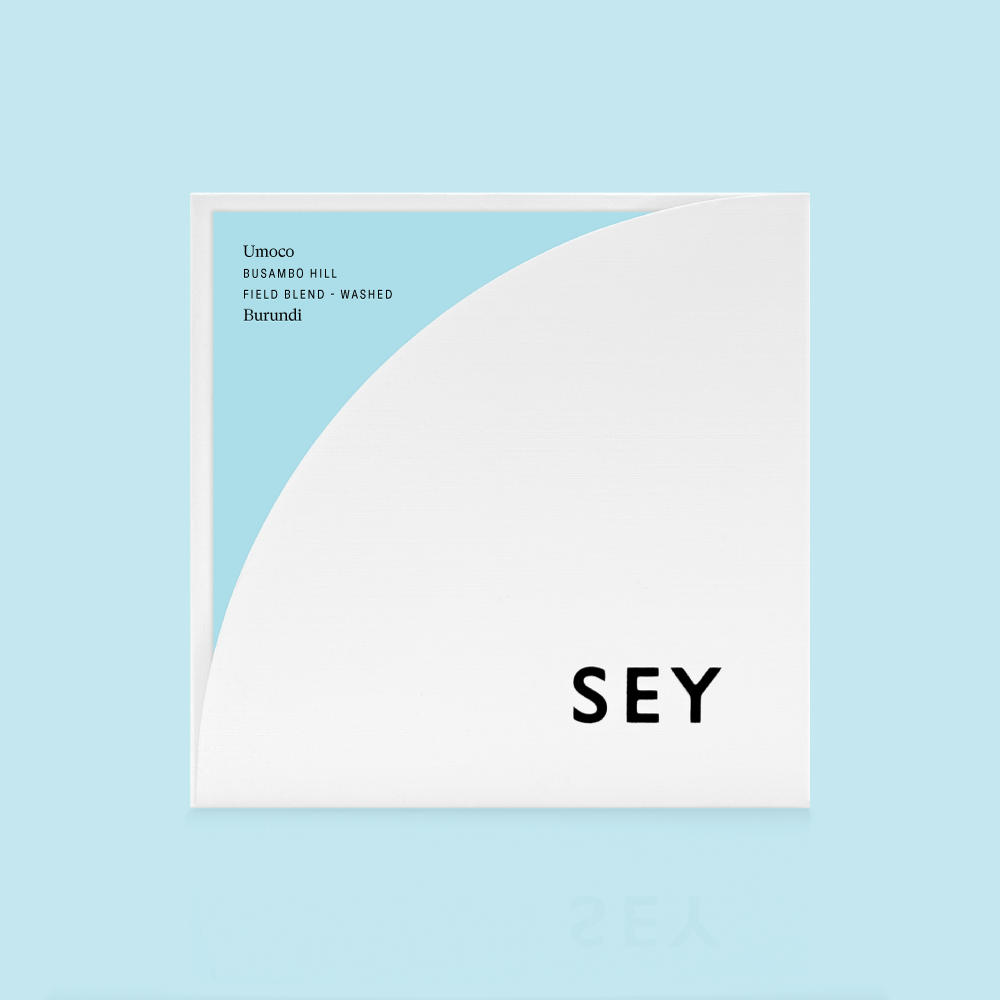
Our first year working with the Umoco washing station continues our exploration of Burundi. Coffees from this region hold a unique place in the landscape of coffee, and we have come to love these profiles over the years. Nowhere produces coffees quite like those found around Lake Kivu in northwestern Burundi. In the cup we find dark fruit leather, black tea, and baking spice.
Field Blend
Kayanza
1,900 masl
May 2025
Hand-picked at peak ripeness. Floated and hand-sorted to further remove defects, then de-pulped on the day of harvest. Fermented twice: dry for 12 hours, then submerged in water for 24 hours. Rinsed in fresh water and density graded. Dried on traditional African raised beds for 16–20 days until moisture content reaches 10.5%.
ABOUT BUSAMBO HILL
This lot comes to us through a new supply chain in Burundi. Coffees from Burundi offer some of the most distinctive profiles we encounter, yet it remains a challenging country to source from. This lot marks the beginning of an effort to expand our exploration of this remarkable origin.
ABOUT THIS FIELD BLEND
Varieties in Burundi are not exactly straightforward. We know that Red Bourbon and Mibirizi are being cultivated; however, we don't know at what relative percentages. Based on the history of production in Burundi there is also most likely some SL34 being grown as well.
Pricing Details

FOB (USD; GREEN)
$8.70/KG

DDP
$14.83/KG
The cost of getting a coffee from cherry to beverage varies enormously depending on its place of origin and the location of its consumption. The inclusion of price transparency is a starting point to inform broader conversation around the true costs of production and the sustainability of specialty coffee as a whole.